


Ethiopian wolf (Canis simensis) is one of Africa’s rare carnivores that lives only in the rugged volcanic Ethiopian Highlands. The canid is recognized by its striking reddish coat and can easily be spotted in the open Afroalpine grasslands. This article explores the species habitat, appearance, behavior, conservation challenges and the best places where visitors may see the wolf.
The Ethiopian wolf resembles a fox by appearance, however. The species belongs to the family of canids and is regarded as a wolf. Among the physical features that distinguish it from other wolves is its reddish-brown coat that covers the whole body. The wolf’s tail a black tip and white markings on the chest, throat, and undersides. The wolf has long legs and slender pointed muzzle built for survival in the Ethiopian highlands. Adults weigh between 11-19 kg and this relatively smaller size makes them agile and precise hunters of small prey.
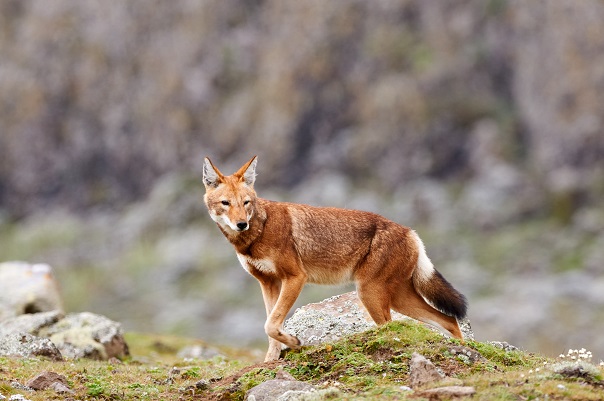
Ethiopian wolf (Canis simensis) is one of the world’s rarest canids, and Africa’s most endangered carnivore
Habitat
The main habitat of the Ethiopian wolf is Afro-alpine and Sub Afroalpine highland vegetation. This unique ecosystem is found at elevations ranging between 3,200-4,500 meters (10,000–14,000 feet) above sea level. At this elevation temperatures range between 10°C-25°C (50°F-77°F) during the day which can drop below freezing point at night. The Afro-alpine vegetation zones where the Ethiopian lives include open grasslands, montane heath and shrubs, Afro-alpine giant lobelias and rosette plants including giant lobelia (Lobelia rhynchopetalum), Kniphofia foliosa. The grasslands dominated by tussock and sedges and unique species such as Festuca abyssinica and Carex monostachya is the most important habitat of the Ethiopian wolf given that grasses harbour prey such as mole rats they form the primary hunting grounds for the canid. The montane heath and shrub vegetation consists of tree species including Erica aroborea (tree heather), Hagenia abyssinica (Kousso), Erica trimera, Hypericum revolutum, Euphorbia dumalis. There are also flowering plants of various colors that form spectacular scenery including Alchemilla ellenbeckii, Cineraria abyssinica, Thymus schimperi, Haplocarpha ruppellii, Arabis alpina, Anthemis tigreensis and Aira caryophyllea.
The species survives both in and outside protected areas including Bale Mountains and Simien Mountains National Parks. Bale Mountains is famous for harboring the highest population of Ethiopian wolves. These protected areas are faced with habitat fragmentation which makes the wolves live in isolated populations and vulnerable to extinction. Although different in habitat, the Ethiopian wolf is often compared with other rare African canids such as the African wild dog.
Diet
The Ethiopian wolf has a unique diet with the primary source of food being small highland rodent species including giant mole-rat (Tachyoryctes macrocephalus), Black-clawed Brush-furred Rat (Lophuromys melanonyx) and Blick’s Grass Rat (Arvicanthis blicki). Among other small mammals such as the Starck’s hare and rock hyraxes are occasionally hunted to supplement its diet. This kind of specialized diet is what distinguishes the Ethiopian wolf from other wolves. The Ethiopian wolf’s hunting behavior is a “stalk and pounce technique.” The wolf moves through the grasslands listening and detecting rodent movements beneath the grasslands. Once prey is detected, the wolf jumps and pounces on it. The wolves are typically solitary hunters given that the rodents are scattered across the habitat. Even though the wolves hunt solitarily, they live in social packs. Each park consists of a dominant producing female and alpha male among other individuals that help to defend the territory. After solitary hunting, a pack reunites and interacts with one another.
Population, threats and conservation status
There are less than 500 individuals surviving in the wild and the Ethiopian wolf is classified as endangered on the IUCN RedList of Threatened Species. Given that over 50% of the population lives outside protected areas making them vulnerable to poaching and habitat loss.
The major threats to the survival of the Ethiopian wolf include as follows:-
Habitat loss is the primary factor that is leading to habitat fragmentation. The fertile volcanic soils and Afro-alpine grasslands are increasingly being encroached on by farmers.
Disease transmission is one of the major threats to the survival of Ethiopian wolves. Rabies and canine distemper virus can spread from domestic dogs when they come into contact with wild wolves. Archives indicate that some wolves in Bale Mountains National Park were affected between 199-199 and in 2003-2004 and 2016 respectively. As such, the Ethiopian Wolf Conservation Programme was established to protect the species and save them from extinction. Through vaccination of domestic dogs to prevent disease transmission. Monitoring and research helps to monitor wolf populations through GPS collar tracking among those in Simien Mountains national park which helps in monitoring of behavior and movements.
Across Africa, several endangered mammals that inhabit semi-desert landscapes face similar conservation challenges, including the Addax antelope.
Where to see Ethiopian wolves
Bale Mountains national park is one of the best places to spot Ethiopian wolves. The protected area is famous for harboring the largest population of Ethiopian wolves. The Sanetti Plateau is the most ideal place to see the canids in the park. Visitors intending to see the wolf should aim to participate in activities including guided nature walks, game drives and horseback riding. In addition to the wolves, the park offers opportunities to spot among other mammal species including Mountain nyala, Menelik’s bushbuck and Bale monkey. The park is also home to over 310 bird species including the Blue-Winged goose (Cyanochen cyanoptera) and Rouget’s rail.
Simien Mountain National Park is another ideal place to spot the endangered Ethiopian wolf. Designated as a UNESCO world heritage, the protected area offers spectacular scenery with dramatic cliffs including Ras Dejen, the highest point in Ethiopia at 4,500 meters above sea level. Wolf sightings in the park may not be guaranteed due to isolated populations, however, visitors can enjoy hiking and trekking and opportunities to spot other unique Ethiopian wildlife species including Walia ibex and the gelada (Theropithecus gelada).
Best time to see the Ethiopian wolf
The dry season from October to March is the best to visit Ethiopian highlands for wildlife viewing. With little or no rainfall, the trekking conditions are easier to access, and there’s clear visibility across the grasslands which makes Wildlife easier to spot. Activities conducted to see the Ethiopian wolf should be conducted responsibly by observing guidelines according to the Ethiopian Wildlife Conservation Authority including maintaining a respectful distance and avoiding disturbing the hunting activities.