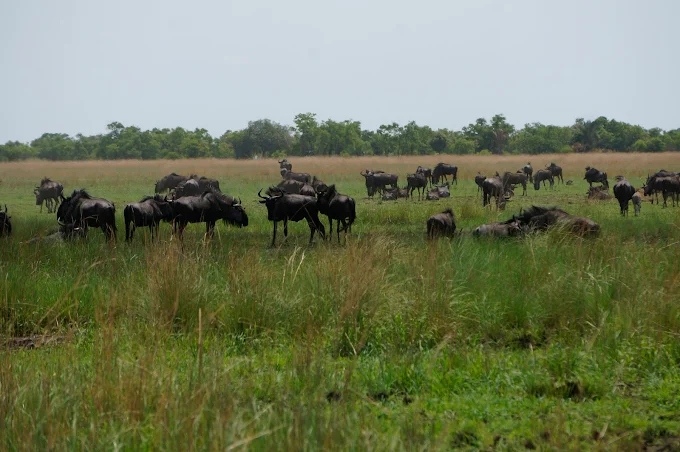
The Liuwa Plain wildebeest and antelope migration is an annual movement of over 40,000 blue wildebeests accompanied by thousands of zebras, tsessebe, reedbucks, and red lechwe from Liuwa Plain to Mussuma region in eastern Angola. The migration is circular in nature following a south and northward direction. It is influenced by seasonal rainfall patterns and flooding of the Zambezi river and its tributaries. The Liuwa Plain landscape contains different vegetation zones including open short grasslands and riparian forests. The open plains in the south-central serve as grazing and calving grounds between November to May. The northern corridor woodlands act as refuge during the dry season between June and October.
The Liuwa Plain wildebeest and antelope migration route and cycle
The southern parts of Liuwa Plain contain Kalahari Sands and alluvial silt soils. Rich in carbonate mineral salts such as calcium, sodium, phosphorus, nitrogen. The short rains of November to December make the grassess and minerals so nutritious for lactating mothers and newborn calves. This attracts animals to migrate from wooded areas in the north to the south for grazing and calving. During the peak flooding season between February to May, the rising flood water levels submerge much of the plains. As a result, the animals will tend to avoid the waterlogged areas and move to the dry ground. They scatter across the south-central areas with some moving west-northwards across the border into Angola.
The dry season begins in June and lasts to October, the southern floodplains retreats and the grasses become thin. The animals migrate northwords to the relatively wetter woodlands which retain water and provide mature grass, trees and shrubs for the browsers. The riparian forests also provide shade during the intense dry season in August and September. The migration cycle continues as the animals must return to the south following the short rains of November and December. The migration largely happens within the Liuwa Plain national park, however, it also extends into the Mussuma region in Angola. As such, the trans-border protected areas are important to protect the world’s second largest wildebeest migration.
Liuwa Plains-Mussuma Transfrontier Conservation Area
The government of Zambia and Angola signed an MoU in 2025 and established Liuwa Plains-Mussuma Transfrontier Conservation Area (TFCA) which stretches for 14,464 Sq. km to protect and safeguard the migration routes and conserve biodiversity for the benefit of people and the planet. Visiting Zambia for safari, the well established Liuwa Plain national park offers an opportunity to witness the Liuwa Plain wildebeest and antelope migration. The Mussuma areas once gazetted into a national park will completely secure the entire migratory route of the second-largest wildebeest migration in Africa and also create opportunities for tourism on the Angola side among other trans-border landscapes in Southern Africa.
