


The African golden cat (Caracal aurata) is endemic to the forests of East and central Africa. Scientific records indicate that the species occurs in West Africa. As such, conservationists think that there may be two subspecies. Which include Caracal aurata aurata found in Central and East Africa and Caracal aurata celidogaster in West Africa. However, a detailed genetic study is still needed. To prove and to determine how clearly the two differ from each other.
The taxonomy of the African golden cat was also recently reclassified. According to the International Union for Conservation of Nature (IUCN) / Species Survival Commission Cat Specialist Group (SSC). Hostorically, the species was placed among the felid family, however. Taxonomists now classify it under the genus Caracal. Given that it was found to be closely related to the Caracal and serval cat. The updated taxonomy is recognized in the (IUCN) Red List of Threatened Species database.
Population distribution and habitat
The African Golden Cat Conservation Alliance (AGCCA). A network of 46 conservationists actively works across 19 countries where the species occurs including Uganda, Tanzania, Gabon, DR Congo, Central African Republic, Sierra Leone, Ivory Coast, Guinea, Liberia, Cameroon, Nigeria and Angola. The species live in and outside of protected areas. AGCCA’s recent surveys discovered just 16 individuals per 100 square kilometers in Gabon and in Uganda’s UNESCO world heritage site of Bwindi Impenetrable national park suggesting that there are low density numbers even in protected areas.
The primary habitat of the African golden cat includes both dense low and montane tropical forests and lives up to the altitude of 3,600 meters above sea level. In addition to dense forests, the cats also live in secondary forests, bamboo, and woodland savannah. Cats prefer a particular habitat for specific reasons. For instance, secondary and regenerating forests attract a high density of rodent species which in turn attract the cats for prey.
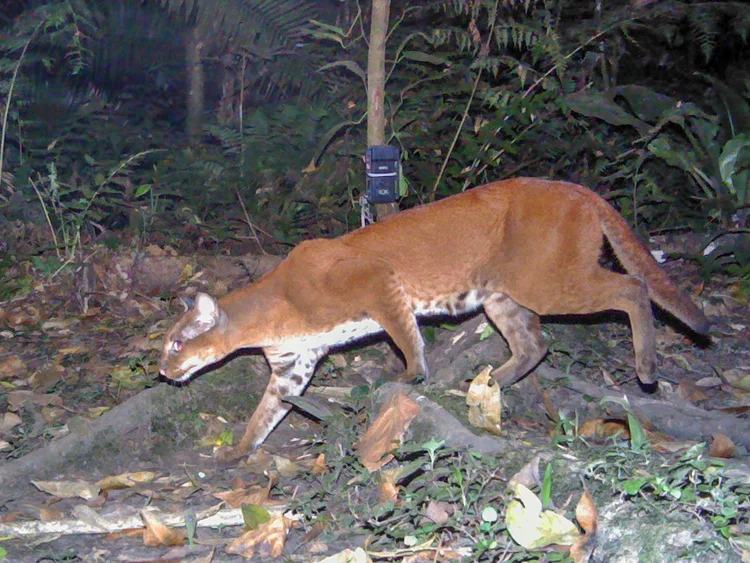
Physical appearance
The African golden cat weighs 11-14 kg and measures 50 cm in height, and 76.2 cm to 144.78 cm in length. It has large paws and stout short legs and is twice bigger than the domestic cat. Depending on the geographical range and habitat, African golden cat fur color varies. It ranges from reddish-brown to slate-greyish coats with or without spots. Other variations include melanistic cats. Source: IUCN/SSC Cat Specialist Group. The African golden cat cheeks have white patches on the cheeks and eyes and dark spots on the belly.
Ecology and behavior
Conservationists are studying the cat in the wild to understand its ecology and behavior. Several ways used in include follows:- field observations and camera trap sensors. Artificial intelligence is being applied in sorting images to identify individual cats basing on coat patterns. Source: CNN, Africa’s ‘cryptic’ golden cat is so rare, no one knows how many there are. AI is changing that. The cats have been observed and photographed in their natural habitat in Gabon’s Lopé and Uganda’s Kibale and Bwindi impenetrable national parks. Among the key findings are that the African golden cat’s survival depends highly on factors like availability of prey, competition from leopards, and human disturbance. For instance, in areas with less competition and disturbance the cats tend to be active both during the day and at night. They preferably hunt mostly rodents, squirrels, and birds. The cats can also hunt much bigger prey including primates and small duikers. Tthe cats were recorded preying on a red colobus monkey which is about 13 kg in Uganda’s Kibale national park.
The natural reproduction rate of the cat seems to be slow. Experimental archives on a pair of captive African golden cats indicate that the gestation period is 75 days and the species produces only two kittens at a time. In the wild the cats can live up to 12 years.
Threats
There’s no clear population estimate of the African golden cats in the wild. This is due to little research and monitoring. To bridge this gap, conservationists are undertaking rigorous surveys across 19 countries. A 3-month survey conducted in 2018 in Guinea-Congo lowland Minziro Forest Reserve in northwest Tanzania discovered a considerable number of cats in the reserve. More surveys conducted in protected areas in Uganda and Gabon revealed that the cats live in low densities with 16 individuals per 100 square kilometers.
In addition, to helping in estimating the population size, the surveys are also helping to detect the threats to the survival of the species. Poaching for bushmeat is the main threat and involves setting of snare traps for duikers and bush pigs. These snares unintentionally trap, injure or kill the cats with over 80 golden cats reportedly caught in snares in Uganda in 2019. Snare traps also threaten the survival of other species including mountain gorillas in Bwindi impenetrable national park. In addition to poaching, other threats include habitat loss putting the African golden at high risk of extinction in the wild. The IUCN Redlist of Threatened Species designated the cat as Vulnerable.
Conservation efforts
To conserve the species there’s need to obtain thorough information on the ecology and behavior and population distribution. Sensitization of communities in southwestern Uganda living around Bwindi impenetrable national park being sensitized to be good stewards of wildlife. The local name of the African golden cat is ‘Embaka’. AGCCA’s founder Mugerwa started an anti-poaching initiative named Embaka. The project works with residents including ex-poachers who have known the species for over 200 years. They help to monitor and report sightings of the African golden cat. Embaka also supports livelihood projects including livestock rearing and dental care that help people to appreciate the benefits of conservation and eventually depend less on the forest for survival.
The African golden cat remains one of Africa’s least understood wild cats, however. The ongoing research and conservation action are beginning to reveal the ecology and behavior while also offering hope for their long-term survival.
Where to see African Golden Cat
The African golden cat is one of the most elusive wild cats in Africa. Because it is secretive and mostly active at night, sightings in the wild are extremely rare. However, the species is known to inhabit dense tropical forests across Central and East Africa.
One of the places where the African golden cat has been recorded is Kibale National Park, a rich rainforest ecosystem famous for its primates and biodiversity. The park’s thick forest provides the ideal habitat for this shy predator, along with other forest wildlife.
Although spotting the cat in person is uncommon, conservation research and camera trap studies have confirmed its presence in the park. Travelers visiting the area can learn more about this mysterious feline through conservation-focused wildlife experiences and research programs.
If you are interested in the possibility of encountering this rare species, you can read more about African golden cat tracking in Kibale Forest National Park, a unique wildlife activity that highlights ongoing efforts to study and protect the species in Uganda.