


The Great Wildebeest Migration is one of the most spectacular wildlife spectacles on Earth. Every year, over 1.5 million wildebeests, accompanied by hundreds of thousands of zebras and gazelles, move across the Serengeti-Mara ecosystem Tanzania and Kenya in search of water and fresh grazing pastures. Their journey follows seasonal rainfall patterns meaning that the best place to stay changes throughout the year accordingly. The Great Migration Safari guide for Serengeti National Park and Maasai Mara National Park offers detailed information on how to this spectacle.
Many first-time safari travelers intending to witness the migration tend to assume that booking the most luxurious lodge guarantees the best experience. In reality, the location is actually more important than luxury. A good lodge located away from the migration route may require long game drives before reaching the wildlife. However, a well-positioned mobile camp can put you right where the wildebeests are at any given time of the year. As a result, knowing the differences between mobile camps, semi-permanent tented camps, and permanent safari lodges will help you choose accommodation that matches your travel goals, budget, and the season of your visit to Kenya or Tanzania for the wildebeest migration safari.
Why Accommodation Matters During the Migration
Given that the migration changes location throughout the year, the accommodation that offers exceptional wildlife viewing in February may not be ideal for calving or river crossings. Choosing accommodation is therefore not only about comfort but also determines how much time you spend watching wildlife instead of driving between your lodge and the migration.
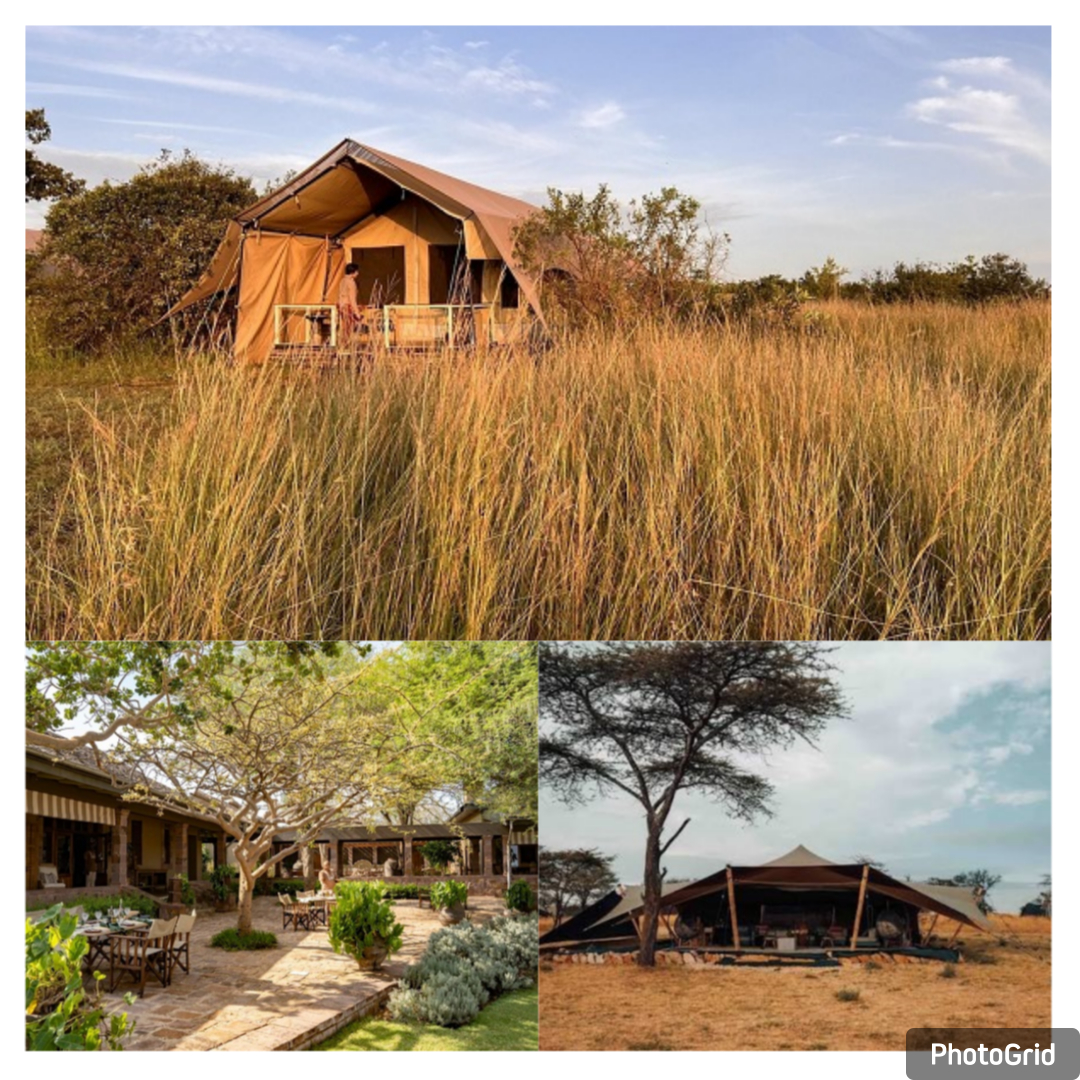
Top: Mobile Camp
Bottom Left: Permanent Safari Lodge
Bottom Right: Permanent Tented Camp
A comparison of the three main accommodation styles: mobile camps that relocate with the migration, permanent tented camps that combine authentic safari charm with modern comforts, and permanent safari lodges offering the highest level of space and amenities.
The Three Main Types of Migration Safari Accommodation
Most migration safaris offer three broad accommodation styles which include luxury mobile tented camps, semi-permanent tented camps and permanent safari lodges. Each serves a different purpose explained as follows:-
Luxury Mobile Tented Camps
Mobile camps are specifically designed to follow the movement of the migration. Rather than remaining in one location throughout the year, operators dismantle and relocate the entire camp several times annually offering the chance to stay close to the herds. Every structure including tents, dining areas, kitchens, staff quarters, and lounges are transported by truck and rebuilt in a new location.
Even though they are called “tented camps,” they offer a surprisingly high level of comfort. Most luxury mobile camps include spacious en-suite safari tents and king or twin beds. Flush toilets, hot bucket or pressure-assisted safari showers. Solar-powered electricity, charging outlets, comfortable lounges, excellent dining, and campfires each evening. These camps prioritize total immersion in nature. Staying amidst and listening to the sound of thousands of wildebeests is a highlight.
How Mobile Camps Follow the Migration
Migration camps generally relocate as follows.
December to March during the calving season, camps establish themselves around the southern Serengeti National Park and the adjacent Ndutu region part of Ngorongoro Conservation Area. This offers an opportunity to witness wildebeests giving birth and predators such as lions, cheetahs and hyenas that roam the plains hunting for easy prey. Mobile camps are ideal for a keen photographer.
May to July
Central Serengeti and Western Corridor
As the southern plains start to dry, the herds begin moving northwest through the Central Serengeti toward the Western Corridor. Many mobile camps relocate closer to the Grumeti River and along the migration routes leading to the north. Visitors can get convenient access to the Grumeti River crossings and the private concessionaire Grumeti Reserve.
Late July to October
This is the season when thousands of wildebeests gather before attempting the dramatic Mara River crossings which occur both in Northern Serengeti Northern Serengeti around Kogatende and Lamai in Tanzania and in Kenya’s Maasai Mara National Reserve. Mobile camps positioned in this region allow visitors to reach crossing points early in the morning before crowds arrive. May to October is the best time to see wildebeest river crossings both at the Grumeti and Mara river.
Advantages of Mobile Camps
The major advantage of mobile camps is staying in a location where the wildebeest migration is already happening. Which offers an opportunity to begin your game drives right away without having to incur a long drive from your camp to find the migration. Among other advantages include smaller visitor numbers, intimate safari atmosphere and raw African bush experience.
Permanent Safari Lodges
Constructed from stone, timber, brick, or concrete, permanent lodges remain in one location. They feature permanent infrastructure, established gardens, swimming or plunge pools, and a wide range of facilities and amenities. Most of them are found in strategic areas where wildlife viewing is almost excellent year-round. For instance, Central Serengeti is famous for harboring resident lions, leopards, elephants, giraffes, and other wildlife throughout the year. Even though these lodges cannot relocate to follow the migration, some of them occupy prime areas along the migration route. Staying at such a lodge offers an opportunity see the herds for a time until they move away.
Advantages of Permanent Lodges
Permanent lodges offer a wide range of amenities including air-conditioned suites, infinity or plunge pools, spas, gyms, wine cellars, family rooms, and larger staff teams. As such, they are often the preferred choice for families, honeymooners seeking resort-style luxury, or those intending to combine wildlife viewing with relaxation.
Semi-Permanent Tented Camps
Semi-permanent camps bridge the gap between mobile camps and permanent lodges. They are designed to leave a minimal environmental footprint. Instead of heavy concrete foundations, the camps are built using elevated timber platforms supported by removable screw piles. Natural vegetation may grow beneath the structures allowing wildlife to move through the camp depending on how elevated the decks are. As such, the camp can be dismantled without permanently altering the landscape.
A balance between wilderness immersion and modern comfort
The level of comfort found in modern tented camps includes spacious bedrooms, solid wooden floors, private verandas, proper beds, flush toilets, pressurized hot showers, glass windows with insect screens, reliable electricity and excellent cuisine. This makes them strike a balance between wilderness immersion and modern comfort.
The Bathroom Experience
Most mobile camps provide private en-suite bathrooms with flush toilets and hot safari showers. Camp staff heat water and fill an elevated reservoir before your shower, delivering a comfortable stream of hot water using far less water than conventional plumbing. Permanent lodges generally have unlimited hot and cold water through standard plumbing systems. Semi-permanent camps often combine modern plumbing with environmentally conscious water management.
Sustainability
Many migration camps operate almost entirely off-grid. Depending on the property, they may rely on solar power, battery storage systems, water conservation measures, waste recycling and locally sourced staff and supplies. These practices help reduce the ecological footprint of tourism within the sensitive wildlife ecosystems.